It’s that time of year again, when the UK Office of Rail and Road releases the numbers for the busiest stations in the United Kingdom.
And, for the third year in a row, it’s London Liverpool Street, with almost 100 million entries and exits.
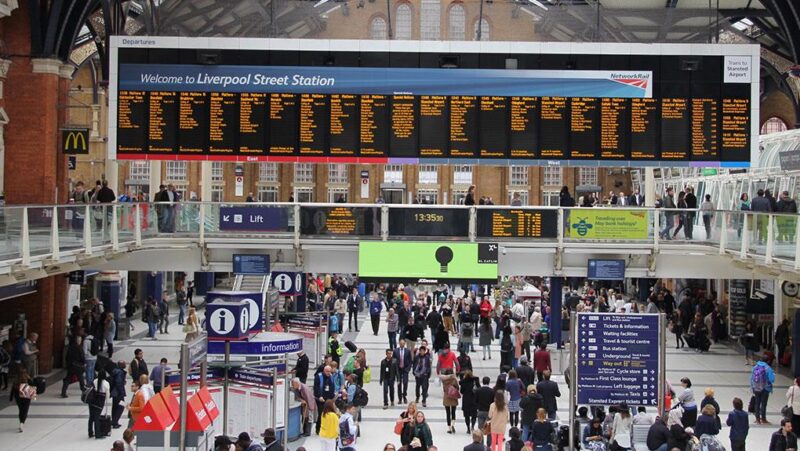
Liverpool Street Station – Image, Network Rail.
With the numbers out, it continues to show the impact of the Elizabeth Line and how it has reshaped travel patterns across London. Its services continue to drive high usage at London Liverpool Street, Paddington, Tottenham Court Road, Farringdon and Stratford.
Six of the top 10 most popular flows – journeys between stations – were between stations served by the Elizabeth line, with 8.7 million journeys between London Liverpool Street and Tottenham Court Road.
The top 10 most used stations in Great Britain
| Rank This Year | Station | Entries and Exits | Rank Last Year |
| 1 | London Liverpool Street | 98.0m | 1 |
| 2 | London Waterloo | 70.4m | 4 |
| 3 | London Paddington | 69.9m | 2 |
| 4 | Tottenham Court Road | 68.1m | 3 |
| 5 | London Bridge | 54.7m | 7 |
| 6 | London Victoria | 53.8m | 6 |
| 7 | Stratford (London) | 51.5m | 5 |
| 8 | Farringdon | 50.2m | 8 |
| 9 | Bond Street | 42.8m | 9 |
| 10 | London Euston | 40.2m | 10 |
Outside London
As regular readers know, I do like to point out that there is life beyond London, with the major rail hubs seeing traffic growth over the year.
Birmingham New Street remains the busiest station outside of London with 36.6 million entries and exits. Manchester Piccadilly remains in second place (27.4m), with Leeds (27.3m) leapfrogging Glasgow Central into third place.
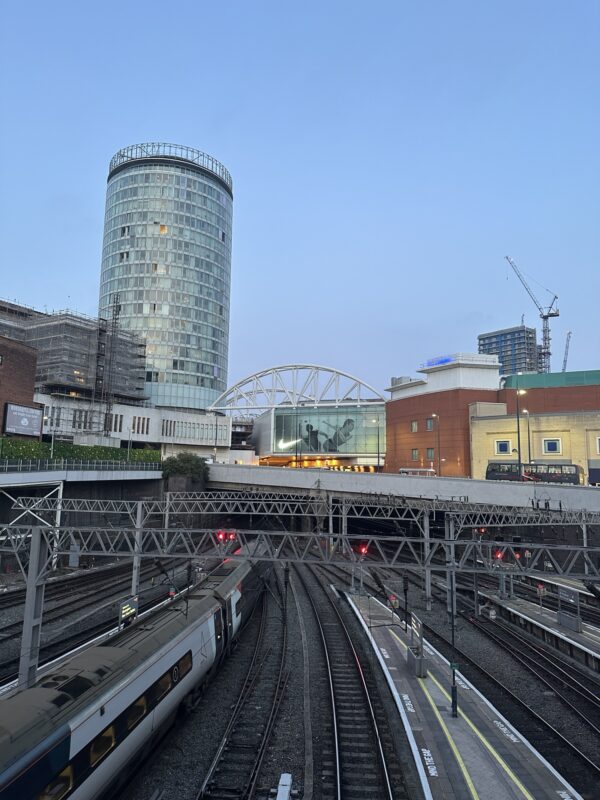
In Scotland, Glasgow Central (25.3m) and Edinburgh Waverley (22.8m) continue to be the country’s busiest stations, maintaining their long-term national rankings.
Cardiff Central is the busiest station in Wales, with 12.5 million entries and exits, with Newport (South Wales) second with 2.8m.
| Rank This Year | Station | Entries and Exits | Rank Last Year |
| 1 | Birmingham New Street | 36.6m | 1 |
| 2 | Manchester Piccadilly | 27.4m | 2 |
| 3 | Leeds | 27.3m | 4 |
| 4 | Glasgow Central | 25.3m | 3 |
| 5 | Edinburgh Waverley | 22.8m | 5 |
| 6 | Gatwick Airport | 21.2m | 6 |
| 7 | Brighton | 15.3m | 7 |
| 8 | Glasgow Queen Street | 15.0m | 8 |
| 9 | Liverpool Central | 14.8m | 10 |
| 10 | Liverpool Lime Street | 14.4m | 11 |
The Least Used Stations
For those content creators who love empty train stations, Elton and Orston in Nottinghamshire was Great Britain’s least used station, with just 68 recorded entries and exits. It was also the least used station in the period from April 2021 to March 2022. Shippea Hill in Cambridgeshire (76) and Ince and Elton in Cheshire (98) also feature among the quietest stations.
Denton in Greater Manchester – last year’s least used station – is now fourth, after the number of entries and exits nearly doubled compared with last year.
| Rank This Year | Station | Entries and Exits | Rank Last Year |
| 1 | Elton and Orston, Nottinghamshire | 68 | 9 |
| 2 | Shippea Hill, Cambridgeshire | 76 | 2 |
| 3 | Ince and Elton, Cheshire | 98 | 3 |
| 4 | Denton, Greater Manchester | 100 | 1 |
| 5 | Reddish South, Greater Manchester | 102 | 5 |
In Quotes
Feras Alshaker, director of planning and performance at the Office of Rail and Road, said:
“This year’s statistics show rail usage continuing to grow around the country, and we’re also seeing the sustained impact of major investment, particularly the Elizabeth line. These insights are vital in understanding how travel patterns are changing and in planning a network that meets passenger needs.”
Passengers in, Passengers Out
Passenger flows are important, as we can see people using the railays and the pressure points at the major hubs. London (as usual) takes the lead with the 10 busiest stations in the country located in the Greater London region, whilst the major regional centres see major passenger flows.
But again, it shows how the Elizabeth Line has transformed travel – introducing new journey options, whilst relieving the congested underground network.
For the ORR, Network Rail and the Train Operators, planning data is helpful to enable network development and growth, as well as to keep those who love numbers crunching them.
Economy Class and Beyond is brought to you by Kevin. They provide a no-nonsense guide to aviation network news, passenger experience insights, honest reviews, in-depth coverage, unique research, as well as the humour and madness I only know how to deliver.
Our Social Media pool has expanded. You can find us across most networks as @economybeyond on BlueSky, Threads, Mastodon and Instagram!
Also, remember that we are part of the BoardingArea community, bringing you the latest frequent flyer news from around the world.