In a saga that’s gone on since November 2020, it’s finally happening – with Korean Air and Asiana Airlines finally integrating into one carrier.
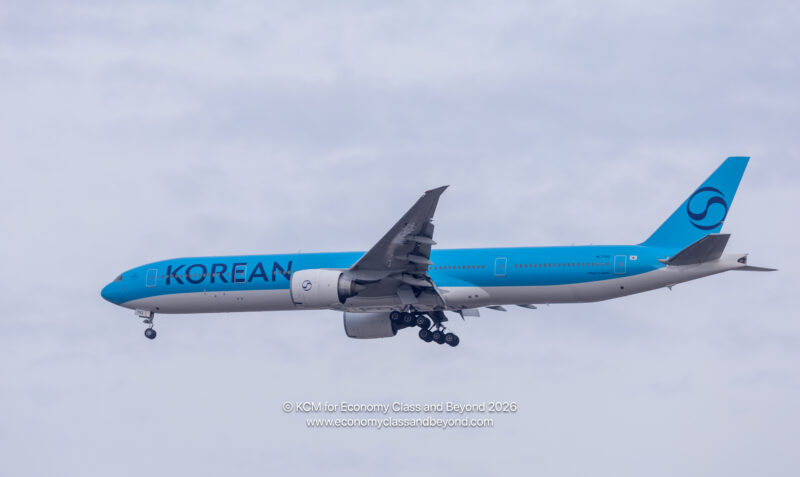
Korean Air Boeing 777-300ER – Image, Economy Class and Beyond.
Korean Air will become “an integrated flag carrier” on 17th December 17, 2026, marking the completion of a consolidation process spanning over five years and beyond. Both the Korean Air and Asiana Airlines boards approved the merger agreement, with them executing the merger on the 14th May 2026.
The agreement follows the initial share subscription agreement signed in November 2020. Upon execution, Korean Air will absorb all Asiana Airlines assets, liabilities, rights, obligations, and personnel. The move was made to stabilise the Korean domestic aviation industry following pandemic-driven losses.
With the notes all executed, Korean Air will submit a merger application to the Korean Ministry of Land, Infrastructure and Transport (MOLIT). In June 2026, the airline will apply for Operations Specifications (OpSpecs) amendments to standardise Asiana Airlines aircraft and safety systems under Korean Air’s existing Air Operator Certificate (AOC).
Once domestic approvals are finalised, Korean Air will proceed with sequential regulatory filings with international aviation authorities to align safety management systems and operational protocols across the expanded global network.
As for services, there are investments ahead, with the airline planning service upgrades, including lounge renewals, catering updates, and terminal relocations to improve passenger experience.
There’s also other work in the background as the airline standardises its flight crew training programmes, as it modernises its Operations and Customer Centre (OCC), Cabin Crew Training Centre, and Aviation Health and Medical Centre to manage the increased volume of staff from both airlines.
And for the MRO arm, there will be an enhanced maintenance infrastructure, including a new engine maintenance plant and an expanded Engine Test Cell (ETC) near Incheon International Airport.
For Frequent Flyers, there will also be changes with the loyalty programmes consolidating into one, whilst the combined airline will have a major footprint at Incheon International Airport for global connectivity, whilst keeping Gimpo Airport as a very useful closer to the city base.
It’s taken long enough.
Nearly six years have passed since Hanjin Group approved the Asiana Airlines acquisition. Since then, there have been bonds, shares, rights offerings, filings left right and centre – as well as the numerous approvals that Korean Air has had to seek from multiple governments and bodies (which in some cases have taken years to achieve).
We’ve seen mergers/takeovers normally take a couple of years… but six years to draw out and get to the end… is a long time for all parties – be you the owner of the airlines, or the passengers wondering what the hell is next.
With a path forward now clearer than ever, it should provide Korean Air the chance it needs to complete the merger by mid-December… providing that there’s minimal further oversight by authorities.
Welcome to Economy Class and Beyond. Your no-nonsense guide to network news, honest reviews, in-depth coverage, unique research, as well as the humour and madness I only know how to deliver.
Our Social Media pool has expanded. You can find us across most networks as @economybeyond on BlueSky, Threads, Mastodon and Instagram!
Also, remember that we are part of the BoardingArea community, bringing you the latest frequent flyer news from around the world.