Technology can be helpful sometimes – in this case, in helping reduce emissions at Amsterdam Schiphol Airport, with them partnering with easyJet to deploy automated taxiing.
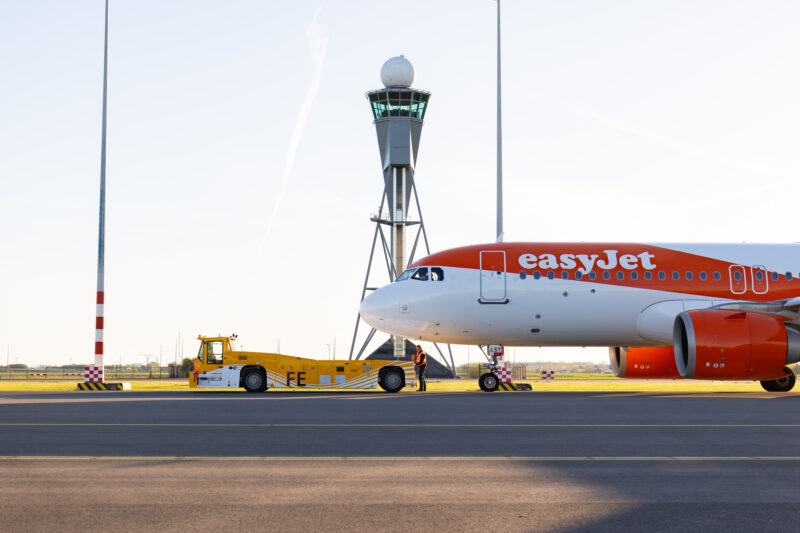
Taxibot and an easyJet A320 – Image, easyJet
Both easyJet and Amsterdam Schiphol Airport are today announcing the rollout of electronic TaxiBot technology for Airbus aircraft operations at Schiphol, following a successful trial earlier this year. The introduction marks another step in easyJet’s ongoing strategy to improve operational efficiency and reduce emissions both in the air and on the ground.
Four easyJet aircraft will be equipped with TaxiBot, in partnership with Schiphol Airport, Menzies, Airbus and Smart Airport Systems (SAS)

Connected at the gate

On Taxi
TaxiBot, funded by the SESAR project HERON, is a semi-robotic, push-pull-free aircraft tractor that enables aircraft to taxi between the gate and runway without using their main jet engines. Instead, the aircraft operates using only its Auxiliary Power Unit (APU), significantly reducing fuel burn, CO₂ emissions and noise during ground operations.
Following an initial and successful test in March, the first easyJet passenger flight took place on 30 April. Three more easyJet Airbus A320neo aircraft are now being fitted with TaxiBot systems permanently as part of the programme, delivered in collaboration with Amsterdam Airport Schiphol, Menzies Aviation, Airbus and SAS.
easyJet estimates TaxiBot will save an average of 95kg of fuel and 299kg of CO₂ per flight, while also reducing noise on the apron. That might sound a lot, but again, multiplied over multiple flights, those savings add up quickly.
Schiphol is the first airport in Europe to deploy electric TaxiBot technology for Airbus aircraft operations. According to Schiphol, large-scale deployment could reduce fuel consumption during taxiing by up to 65%, while also significantly reducing CO2, NOx and ultrafine particle emissions.
The deployment forms part of Schiphol’s wider ambition to build a future that is more in harmony with the environment. Together with airlines such as easyJet, ground handling operators, Air Traffic Control and the Netherlands and Smart Airport Systems, Schiphol is developing solutions that make a difference in day-to-day operations, such as the electric TaxiBot.
In Quotes
Speaking on the rollout, David Morgan, Chief Operating Officer at easyJet, said:
“TaxiBot is another important step in our mission to operate as efficiently as possible. This technology delivers immediate reductions in fuel consumption, carbon emissions and noise, while supporting more efficient ground operations at one of Europe’s busiest airports.
As we continue to modernise our operations, initiatives like this demonstrate how innovation and collaboration across the industry can help reduce aviation’s environmental impact both in the air and on the ground.”
Esmé Valk, Chief People & Transformation Officer at Amsterdam Airport Schiphol, said: Schiphol:
‘By deploying the TaxiBot, we’re taking another practical step towards reduced emissions and noise on the apron. This is how we’re creating a healthier and cleaner workplace, and an ever more sustainable and modern airport that is ready for the future.’
Miguel Gomez Sjunnesson, EVP Europe at Menzies Aviation, said:
“The introduction of TaxiBot at Schiphol shows what can be achieved when technology and collaboration come together. At Menzies, we’re focused on using solutions that improve efficiency and cut emissions. We’re working closely with Amsterdam Schiphol Airport and easyJet to make these changes part of everyday operations, while creating a cleaner, healthier environment on the ramp.”
Savings that add up
With airports and aviation contributing to emissions and noise, ways to reduce this are going to become more important as the industry itself tries to become at least carbon reducing, and eventually carbon neutral.
Along with that are the cost savings, too, because companies never act from the goodness of their corporate hearts. They have shareholders who need payment. Whilst equipment costs may seem high at the start, over the life of use, along with the fuel savings, they can add up quickly (especially in higher fuel cost environments such as today).
With it being able to help offer a better environment for workers, this is only a positive thing.
The challenge will be how to extend this offering beyond four aircraft and change an industry mindset.
Images, easyJet.
Welcome to Economy Class and Beyond. Your no-nonsense guide to network news, honest reviews, in-depth coverage, unique research, as well as the humour and madness I only know how to deliver.
Our Social Media pool has expanded. You can find us across most networks as @economybeyond on BlueSky, Threads, Mastodon and Instagram!
Also, remember that we are part of the BoardingArea community, bringing you the latest frequent flyer news from around the world.
Leave a Reply